Indicators

The indicators in the Environmental Data Compendium are updated regularly. Below is the list of the last updated indicators. Using this page, you can easily see which indicators were updated since your last visit.
36 indicators
Filter by topic
Filter by period

Manure surpluses in agriculture, 1970-2023

Between 1970 and 2023, the nitrogen surplus in agriculture has fallen by about 49 percent. The surplus did not change a lot in the last ten years and we see a small decreasing undulating trend…

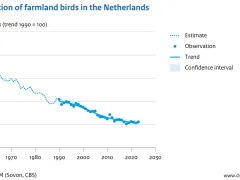
Trend fauna - all species monitored - Living Planet Index Netherlands, 1990-2023

The Living Planet Index of the Netherlands has increased with 13% since 1990. Species of aquatic and marshland habitats have increased considerably, whereas terrestrial species decreased in the past…

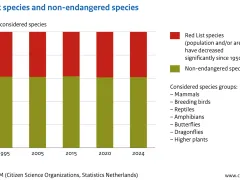
Number of threatened and extinct species in The Netherlands, by 2024

Officially assembled Red Lists show that many Dutch plant and animal species are threatened with extinction.

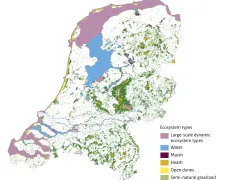
Nature types in the Netherlands, 2023

Nature in the Netherlands can be divided into different ‘types’ of natural and semi-natural areas. Since 2008 the standard classification for this has been the Nature and Landscape Index (Index NL)…

Environmental quality of terrestrial ecosystems: nitrogen deposition 1994–2022

Nitrogen deposition has declined since the 1990s, leading to an improvement in the environmental quality of terrestrial ecosystems. This improvement in environmental quality stalled in 2010, but…

Membership of Dutch private nature conservation organisations, 1989-2023

The combined membership of the four biggest nature conservation organisations in 2023 was 1,744,716 members/donors. Natuurmonumenten had the most members/donors (851,441), followed by the World Wide…

Angling in the Netherlands, 1990-2022

In 2020 more than 700,000 active anglers were members of an angling club in the Netherlands and holders of the national fishing permit. The Covid-19 restrictions led to a significant increase in the…

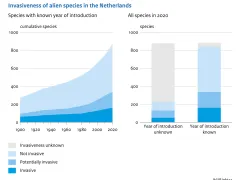
Alien species in the Netherlands, 1990-2020

The number of new species becoming established in the Netherlands as a result of human agency is growing rapidly. Most of these alien species are terrestrial arthropods (insects) and plants. In recent…

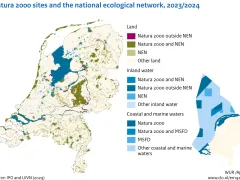
Spatial conditions of the national ecological network, 2021

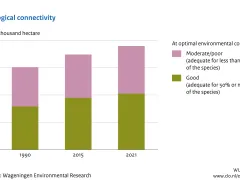
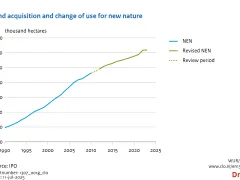
The increase in the area of new nature since 1990 has improved the size and connectivity (spatial conditions) of terrestrial ecosystems in the Netherlands. However, a considerable part of the national…

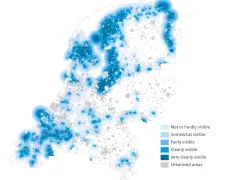
Landscape openness

The most open areas in the Netherlands are the large water bodies, the northern marine clay and peat areas and the IJsselmeer polders. The most enclosed and small-scale landscapes are found throughout…